
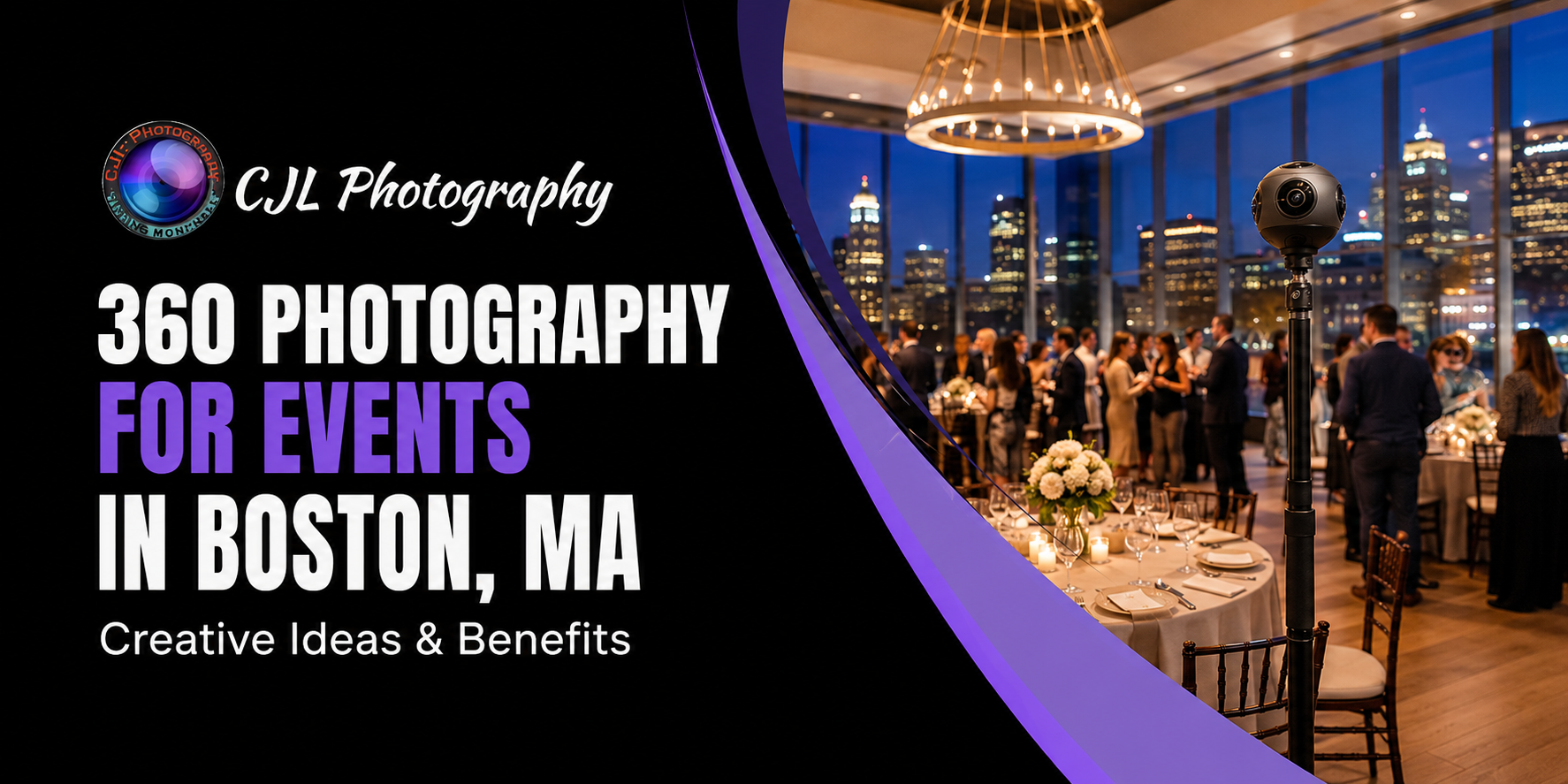
“360 photography” covers two different things, and it helps to know which one you’re shopping for. For most event hosts in Boston, it means the spinning video setup: guests step onto a platform, a camera circles them, and moments later they have a slow-motion clip ready to post. For venues and businesses, it often means panoramic photos and virtual tours that let someone look around a space.
Both can make an event stronger. This guide explains how 360 photography works, what it adds to different types of Boston events, how it compares with traditional photography, and how to plan and hire for it.
Quick Takeaways
- Event 360 is usually a short, slow-motion video that guests share themselves. It’s an experience as much as a service.
- It works for weddings, corporate events, parties, graduations, brand activations, and galas, but each one needs different planning.
- It complements traditional event photography. It doesn’t replace it.
- Space, power, and venue rules decide more than most people expect. Check them early.
- When you hire, compare what’s included, not just the price.
What Is 360 Photography?
At its simplest, 360 photography captures a subject or space from all the way around instead of from a single angle. The term gets used for two quite different services:
| Type | What It Is | Common Event Use | Typical Output |
| 360 video booth (event 360) | A camera on a rotating arm circles guests standing on a platform | Guest entertainment, branded content, social sharing | Short slow-motion video clips |
| Spherical 360 photos and virtual tours | Panoramic images stitched into an interactive, look-around view | Showing a venue before booking, documenting a setup, hosting a virtual walkthrough | Interactive image or tour viewed online |
If you see a quote for “360 photography,” ask which one it covers. Photographers who build virtual tours of spaces and companies that rent 360 booths are doing different work, even though they share a name.
How 360 Photography Works for Events
Here’s the typical flow for a 360 booth at an event:
- Setup. The provider sets up the platform, camera arm, lighting, and backdrop before guests arrive, and tests the equipment.
- Guests step on. An attendant explains what to do, and guests pose, dance, or act out a moment.
- The camera circles. The arm rotates around the group while the camera records, usually in slow motion.
- Processing. The clip is edited on the spot, often with music, effects, and branded overlays.
- Sharing. Guests receive the video through a QR code, text, email, or a shared gallery.
A good attendant keeps the line moving, suggests poses, and makes sure guests feel comfortable on the platform. That human element matters more than the equipment.
What you need to provide: enough floor space for the setup, access to power, and, if you want instant sharing, a reliable internet connection or an offline option. Your provider will tell you the exact requirements, so ask early.
The other kind of 360, spherical photography, works differently. The photographer shoots overlapping images from a fixed point and stitches them into an interactive view. At events, this is most useful for showing a venue to planners or attendees in advance, or documenting a space.
Benefits of 360 Photography for Boston Events
Boston events happen across a mix of hotels, historic buildings, university spaces, restaurants, and convention venues, often indoors for much of the year. A few benefits stand out in that setting:
- Guests do something, not just watch. A 360 setup gives people a reason to gather, laugh, and take part.
- Content that guests share themselves. Short videos fit the formats people already use on social platforms.
- Works for mixed crowds. Out-of-town visitors, coworkers, and family members of all ages can enjoy it without any skill.
- Fills the quiet moments. It gives guests something to do during cocktail hours, breaks between sessions, or waiting periods.
- Branded content that doesn’t feel like an ad. Logos and overlays appear in something guests chose to make.
- Flexible across event types. The same basic setup can be dressed up for a wedding or branded for a product launch.
It isn’t right for every event. A quiet memorial or a formal ceremony probably doesn’t call for it. It works best when the mood is social and celebratory.
360 Photography for Different Types of Boston Events
360 Photography for Weddings in Boston
Weddings are about people, and 360 gives guests something fun to do together. It tends to work best during cocktail hour or after dinner, when guests are mingling.
Planning note: Place it away from the dance floor and main walkways so it doesn’t create a bottleneck. Choose a backdrop that matches your decor, and ask the venue about floor, power, and placement rules. Many couples also like having a gallery of clips delivered afterward as a keepsake.
360 Photography for Corporate Events
For companies, 360 is both entertainment and content. Conferences, product launches, holiday parties, and team events can all use it to encourage interaction and create branded videos.
Planning note: Put it where traffic is highest, such as near registration or a sponsor area. If you plan to collect guest emails or other information, make sure you have appropriate consent and a privacy-compliant process. Decide in advance what you want to measure, such as participation, shares, or leads.
360 Photography for Birthday and Private Parties
Milestone birthdays, anniversaries, bar and bat mitzvahs, and family celebrations are natural fits. Guests of all ages tend to enjoy it, and the clips make memorable keepsakes.
Planning note: Confirm the platform’s limits for the number of people at once and ask about supervision for younger guests. Themes (costumes, color schemes, decade parties) make the clips feel more personal.
360 Photography for Graduations and School Events
Graduation parties, proms, and school celebrations produce large groups who all want a turn. Throughput matters here, so ask about how quickly the provider can keep the line moving.
Planning note: Schools and universities often have vendor approval processes, insurance requirements, and rules about photographing minors. Check them well in advance and get permission where required. Choose props and music that suit the audience.
360 Photography for Brand Activations
For brands, 360 can turn a booth, pop-up, or sponsored space into something people stop for. Guests create content that carries your logo, hashtag, or product into their own feeds.
Planning note: Define the goal first: foot traffic, social reach, lead collection, or product demonstration. Build the branding into the experience, not just a logo in the corner. If the activation is in a public space, check whether permits apply.
360 Photography for Galas and Special Events
Galas call for a more polished look. A well-styled 360 setup with an elegant backdrop can become a highlight of cocktail hour, and sponsors can be recognized with subtle branding.
Planning note: Keep the design restrained and the line short. Pair it with a traditional photographer for formal portraits and candid coverage. For fundraising events, ask whether sponsor messages or donor recognition can be built into the clips.
360 Photography vs. Traditional Event Photography
They do different jobs. Here’s how they compare:
| 360 Photography (Event Booth) | Traditional Event Photography | |
| What you get | Short slow-motion videos | Still photos of moments, people, and details |
| Guest role | Active participants | Subjects, often unposed |
| Storytelling | Fun, playful moments | Candid coverage and a full record of the event |
| Formal portraits | Not designed for them | Yes |
| Sharing | Instant, guest-driven | Usually after editing and delivery |
| Best for | Engagement and social content | Documentation and lasting memories |
| Limitations | Only captures people who step up | Doesn’t create an interactive guest experience |
How to choose: If your priority is a complete record of the event, traditional photography comes first. If your priority is guest engagement and shareable content, add 360. For most weddings, galas, and corporate events, the best answer is both, with each doing what it does best.
How 360 Photography Creates Engaging Social Media Content
Guests are happy to post a video of themselves. That makes 360 content different from a brand’s own posts. It’s made by people, for people.
To get the most from it:
- Make sharing effortless. A QR code or text link that works in seconds beats a form guests have to fill out.
- Use a simple, memorable hashtag and display it where guests will see it.
- Add branding thoughtfully. A clean overlay or end card works better than a busy design.
- Pick music carefully. Ask the provider about music options that are cleared for sharing on social platforms.
- Collect highlights for your own channels, with guests’ permission.
- Create a recap. A short highlight reel of the best clips can extend the event’s reach after it ends.
If you plan to use guest clips in marketing, set that expectation clearly through signage or consent language, and confirm the terms with your provider.
Creative 360 Photography Ideas for Events
A little creativity turns a booth into a feature of the event:
- Themed backdrops and props that match the event, from black-tie to New England-inspired.
- Confetti or streamer moments, if the venue allows them.
- A “message to the couple” or “message to the team” video, where each guest says a few words.
- A product reveal on the platform for launches and brand events.
- Solo, duo, and group rounds, so every guest finds a comfortable format.
- Costume or decade themes for private parties.
- A branded end card with the event name, date, and hashtag.
- A mid-event backdrop change to create two “looks.”
- Slow-motion dance and movement that takes advantage of how the clips are processed.
- A 360 virtual tour of the venue sent to guests or sponsors before the event so they know the layout.
Choose one or two ideas and do them well. Too many effects can make the clips feel cluttered.
How to Prepare for a 360 Photography Session
Preparation is mostly about logistics. This timeline is a guide, so adjust it to your event:
| When | What to Do |
| As early as possible | Set your goals and budget. Check the venue’s vendor rules. Book your provider, especially for busy dates. |
| About a month out | Confirm placement, floor space, power, and internet. Ask about insurance requirements. Plan load-in and setup times. |
| 1 to 2 weeks out | Finalize the backdrop, overlay design, music, hashtag, and sharing method. Decide how you’ll manage the line. |
| Event day | Confirm arrival time and contact person. Walk through placement. Test a run before guests arrive. |
| After the event | Confirm delivery of galleries and any usage permissions. |
A few extra tips:
- Pick a spot that’s easy to find but not in the middle of foot traffic.
- Leave room around the setup so people can watch and wait.
- Brief your own team or planner so they can direct guests.
- Check the weather plan if the setup is outdoors.
Choosing a Professional 360 Photographer in Boston
Experience with events like yours matters more than a long list of features. Here’s what to compare:
| Question | Why It Matters |
| What exactly is included? | Hours, attendant, setup and teardown, overlays, sharing, and gallery delivery vary |
| Do they have event experience at venues like yours? | Hotels, universities, and convention spaces often have specific rules |
| Are they insured? | Many venues require a certificate of insurance |
| What’s the backup plan? | Equipment can fail, and you want to know what happens then |
| Can you see sample work? | Look for clean, stable, well-lit clips |
| How is sharing handled? | Ask about internet requirements and offline options |
| What are the contract terms? | Check cancellation, overtime, and usage rights |
| Which type of 360 do they offer? | Confirm whether it’s event booth video, virtual tours, or both |
What affects cost: event length, setup and travel, customization, number of attendants, and demand on your date. Quotes can vary widely, so compare what’s included, not only the bottom line. A lower price that leaves out an attendant or sharing may not be a bargain.
Look at independent reviews and ask for references if you want extra reassurance.
How 360 Photography Can Make Your Boston Event More Memorable
The benefits above are practical. The lasting value is emotional: people remember moments they took part in.
Picture a corporate holiday party (a hypothetical example). Most of the evening blends: food, conversation, a few speeches. But the video of three coworkers laughing on the platform gets passed around the next morning. It gives people something to talk about, and something to rewatch.
That’s what 360 adds. It creates a small, shared event within the event, with a keepsake attached. A few things help it stick:
- Place it where the energy already is.
- Keep the experience quick and easy.
- Make the clip look good enough that guests want to share it.
- Follow up with the gallery or highlight reel so the moment lasts.
About CJL Photography
CJL Photography is a commercial photography business serving the Northeast, with Boston among its listed service areas. Its owner describes himself as the first certified Google Street View for Business photographer in New Hampshire, creating 360-degree virtual tours since 2012. That experience is especially relevant for venues, hotels, and restaurants that want to showcase their spaces to event planners and guests.
If you’re planning an event or want to discuss 360 imagery for a venue, you can get in touch through the contact page.
Frequently Asked Questions
How many people can fit on a 360 platform at once?
It depends on the equipment. Most setups handle a small group at a time, but capacity and weight limits vary, so ask your provider.
Can a 360 booth be used outdoors?
Often yes, but conditions matter. Wind, rain, uneven ground, and bright sun can all be problems. Ask about weather plans, flat surfaces, and any covering needed.
Can guests get their videos without Wi-Fi?
Some setups can create and store clips offline and deliver them later, while others rely on a connection for instant sharing. Ask which applies and what happens if the signal is weak.
Do I need a certificate of insurance for my venue?
Many venues require vendors to provide one, and some have approved vendor lists. Ask your venue early, then confirm your provider can meet the requirements.
How far ahead should I book?
As early as you can, especially for peak periods like wedding season, graduation season, and the holidays. Popular dates fill up, and some events need extra time for venue approvals.
Is 360 photography accessible for all guests?
It depends on the platform and setup. Ask about steps, ramps, seated options, and weight limits so everyone can take part comfortably.
Who owns the videos, and can I use them in marketing?
That’s set by your contract. Clarify who owns the content, how guests’ videos can be used, and whether you need releases or signage for marketing use.